
What Is Nannari? The Indian Root With Powerful Health Benefits
June 1, 2026 2026-06-01 16:38What Is Nannari? The Indian Root With Powerful Health Benefits

What Is Nannari? The Indian Root With Powerful Health Benefits
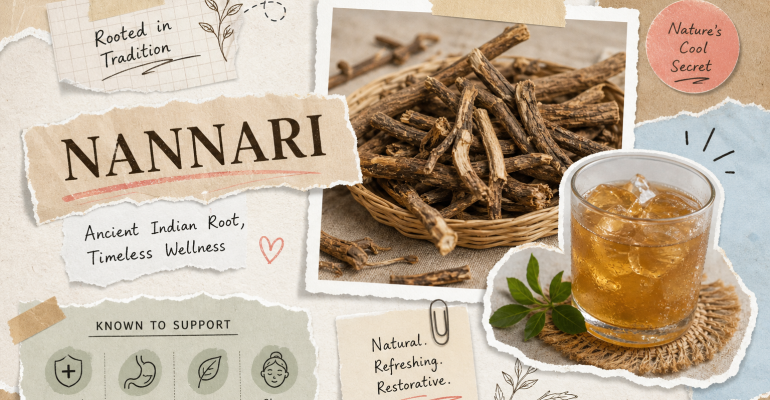
The thick, pressing heat of an Indian summer has a way of stripping everything back to basics. No packaged drink quite answers it. What does answer it, in millions of South Indian homes, is a tall glass of something dark and earthy, slightly sweet, with a scent that’s somewhere between soil after rain and dried bark. That drink is nannari sarbath (also spelled sharbath or sharbat), and the root behind it is one of traditional medicine’s most quietly respected ingredients. Known botanically as Hemidesmus indicus and commonly called Indian sarsaparilla, this root has been used across Ayurvedic and Unani systems for centuries to cool, cleanse, and restore.
At Dr. Talat’s, it forms the heart of the Nannari Sharbath, a ready-made formulation built on that same ancient foundation. This article covers what the root is, why traditional healers valued it, what it actually does for the body, how to make nannari sarbath at home, and how to find the real thing if you’d rather not start from scratch.
What nannari actually is: the plant, the root, and the names behind it
The botanical identity: Hemidesmus indicus
Hemidesmus indicus is a perennial, twining shrub native to the Indian subcontinent, found across South India, Sri Lanka, and parts of Southeast Asia. It threads itself upward with slender, angular stems, opposite lanceolate leaves, and small fragrant clustered flowers. None of that is the part anyone cares about. The value of this plant lives entirely underground, in a long, wiry taproot with a distinctly earthy, slightly sweet aroma that any serious herbalist recognizes immediately. That root is the only part traditionally harvested and used. For a concise traditional overview of the plant and its names, see the entry on ananthamoola (Hemidesmus indicus).
Traditional names across cultures
The plant carries different names depending on which tradition you come from. In Sanskrit, it’s ananthamoola, which loosely translates to “endless root”, a name that probably refers to the taproot’s length and, perhaps more poetically, to the breadth of its applications. In Tamil and Malayalam, it’s nannari. In English colonial botanical records, it was catalogued as Indian sarsaparilla or false sarsaparilla, borrowing a name already familiar to European traders from American species with similar folk uses. The plants are not the same species. But the overlap in traditional application across such different cultures and continents says something worth noticing about what this root actually does.
Why ancient healers took this root seriously
In Ayurveda: sheeta virya and pitta balance
Ayurveda classifies nannari root as having “sheeta virya,” or cooling potency. That classification is not poetic language; it reflects a specific therapeutic logic. Pitta-dominant conditions, excess internal heat, inflammation, burning sensations, and skin disruptions tied to heat accumulation, are where the root was consistently applied. Ayurvedic texts list it as a blood purifier and urinary tonic, and it appears repeatedly in formulations for conditions that worsen with summer heat. In coastal and tropical communities across Kerala and Tamil Nadu, that made it a seasonal staple rather than a medicinal curiosity.
Unani medicine’s use of ananthamoola
Unani medicine arrives at nearly identical conclusions from a different framework. In classical Unani practice, the root functions as a musakkin (calming agent) and musaffi-dam (blood purifier), with its cooling and cleansing properties used to correct constitutional imbalances involving heat and inflammation. What’s striking is that two distinct medical systems, with entirely different foundational theories about how the body works, converged on the same applications for the same root. That cross-system validation is not clinical proof, but it’s a pattern worth taking seriously when you’re trying to understand why a plant stayed in active use for centuries.
What this root does for the body: the honest picture
The cooling effect and what the evidence actually says
The cooling claim is real, but it’s grounded in traditional use and Ayurvedic theory, not in randomized human trials. To be direct: there are no high-quality clinical studies proving that this root reduces body temperature or treats any specific condition in humans. What exists is a strong record of traditional use, preliminary phytochemical research pointing to saponins, mucilage, and flavonoids as plausible contributors to anti-inflammatory and soothing effects, and generations of consistent application in some of India’s hottest regions. In Kerala, nannari sarbath was consumed daily during peak summer months, sold by street vendors known as “sarbath kaarans,” and shared at family gatherings as routine summer wellness. That consistency of use across time and geography deserves more credit than modern consumers tend to give it.
Digestion, blood purification, and what “detox” actually means here
The digestive applications are also traditionally well-established: relieving acidity, easing constipation, supporting appetite, and calming the gut after heat-related disruption. These are not clinical guarantees, but they come from consistent multi-generational use across Ayurvedic and Siddha systems. “Blood purification,” in the traditional sense, means supporting the liver, clearing accumulated metabolic waste, and improving skin clarity, particularly in conditions like eczema and acne that traditional medicine links to internal heat. It does not mean what modern detox marketing implies. That distinction matters practically, not just semantically.
A practical note on safety: in food-grade preparations like sarbath, the root is generally well tolerated. Some people experience mild stomach upset or increased urination. Anyone with kidney disease, a history of severe allergies, or who is pregnant should consult a healthcare provider before consuming it regularly. The research on safety during pregnancy is not strong enough to recommend it without professional guidance; for general consumer-facing safety information on related sarsaparilla products, see WebMD’s sarsaparilla overview.
How to make nannari sarbath at home the traditional way
What you need
The ingredients are few and the process is straightforward, but the sourcing determines everything. Pale, weak-smelling roots make pale, weak syrup, so start with good material.
- 50 g dried nannari root (outer dark bark only; discard the white inner stalk)
- 1 liter water
- 1 cup sugar
- 1 to 2 tablespoons fresh lemon or lime juice
- Ice, for serving
From root to glass: the method
Rinse the roots thoroughly to clear any sand or grit. Separate the white inner stem from the darker outer root material and keep only the darker portion. Crush it coarsely with a mortar, a rolling pin, or the back of a heavy knife. Soak the crushed root in 1 liter of water for 6 to 8 hours or overnight.
Bring the soaked mixture to a gentle boil, then reduce to a steady simmer until the liquid cuts down by roughly half and turns a deep, warm brown with a noticeable herbal scent filling the kitchen. Strain it well through fine mesh or muslin. Return the strained liquid to the pot, add the sugar, and simmer until the syrup lightly coats the back of a spoon. Stir in the lemon juice, take it off the heat, and cool completely before transferring to a clean glass bottle.
To serve, mix 3 tablespoons of syrup into a glass of chilled water with ice and a squeeze of fresh lime. Stored in the refrigerator with a dry spoon, the nannari syrup holds well for up to two months. Room temperature storage cuts that to about a week, so refrigeration is the practical choice for anyone making a larger batch.
Choosing authentic nannari: what to look for and when to skip the effort
Red flags in roots and syrups
Authentic dried root is thin, wiry, and fibrous, with an earthy-sweet aroma you notice immediately on opening the package. Roots that look thick, uniform, or wood-like, or smell flat and inert, are worth questioning. The same scrutiny applies to nannari syrup. A product that’s overly bright in color, excessively sweet with little herbal depth, or tastes more like caramel flavoring than root extract should raise questions. Always look for the botanical name Hemidesmus indicus on the label. Local names like “nannari” or “sarsaparilla” can apply to more than one plant in regional trade, and without a botanical identifier you have no way of knowing what you’re actually buying. GMP-certified or third-party tested products provide a more reliable baseline than unlabeled market roots, where adulteration is common and difficult to detect without lab analysis.
Why a trusted ready-made formulation often makes more sense
Sourcing quality nannari root in urban India takes genuine effort. Root quality varies widely across suppliers. The preparation process takes the better part of a day. And shelf stability is a real practical concern when you’re not making it fresh each week. For anyone who wants the genuine cooling and digestive benefits of this root without the sourcing guesswork, Dr. Talat’s Nannari Sharbath is the practical answer. It’s a properly sourced, prepared concentrate built on an authentic herbal base, developed within a Unani wellness framework that treats this ingredient with the seriousness it deserves. No artificial colors, no synthetic preservatives. Just the root, prepared properly, ready when the heat arrives.
Frequently asked questions about nannari sarbath
Is nannari sarbath safe to drink every day?
In food-grade amounts, the root is generally well tolerated by healthy adults. Most people consume it seasonally, daily through summer months, without issue. If you have kidney disease, are pregnant, or take regular medication, check with a healthcare provider before making it a daily habit.
What is the correct dosage for nannari syrup?
Traditional practice calls for 2 to 3 tablespoons of syrup diluted in a glass of cold water, once or twice a day during summer. This is a food-grade serving, not a therapeutic dose. Follow any specific guidance on the product label.
How long does homemade nannari syrup keep?
Refrigerated in a clean glass bottle and handled with a dry spoon, it keeps well for up to two months. At room temperature, plan to use it within a week.
What’s the difference between nannari and sarsaparilla?
Hemidesmus indicus (Indian sarsaparilla) and American sarsaparilla are different plants from different botanical families. They share a common folk name and some overlapping traditional uses, but they are not interchangeable. When buying nannari, always verify the botanical name on the label.
A root that earned its reputation quietly
Indian sarsaparilla has stayed in use across centuries not because of marketing or trend cycles, but because it worked. Season after season, in homes across South India, people reached for it when the heat came and found something that answered. Its place in both Ayurvedic and Unani medicine, and its consistent presence in South Indian kitchens across generations, are not coincidences. They are the accumulated result of a lot of summers and a lot of people who paid careful attention to what actually helped.
Whether you make nannari sarbath from scratch with dried roots and a full afternoon, or you reach for a well-made bottle, the point is the same: this is one of those ingredients worth knowing. If the seasonal heat has you reaching for cold drinks, it might be worth reaching for one that actually has roots. Shop Dr. Talat’s Nannari Sharbath, made from authentic Hemidesmus indicus, prepared within a Unani wellness framework, and ready for exactly that moment.




Comments (7)
mcluckapp
This app has become my daily go to for quick gaming sessions. I appreciate how smooth the navigation is and how fair the bonus rounds feel. No hidden tricks just solid entertainment whenever I need a break. mcluckapp
npak8bet
I have been looking for a secure betting environment that actually respects player privacy and this place checks every box. The daily promotions are genuinely rewarding and I never feel pressured to deposit more than I planned. It is a refreshing space that puts the user first. npak8bet
ecmeritbet
Just found this platform and I am really impressed with the game selection. The payments are super fast and customer service is always ready to help. If you are looking for a reliable place to play slots and live casino games this is definitely worth a try. I have been playing here for a few weeks and the experience has been smooth every single time. Thanks to the team for keeping things fair and exciting. ecmeritbet
bdkhela888
Really impressed with the variety of games here. It is refreshing to find a site that actually pays out on time. Cheers to bdkhela888 for the awesome service.
pkji8888
Fast withdrawals and great customer support. It is rare to find a platform this reliable these days. Trust pkji8888 for your gaming.
pklucky81
Finally found a platform that actually feels lucky. The bonuses are generous and the customer support is surprisingly quick. Give pklucky81 a try.
kratonbetslot
The slot variety here is insane. I hit a decent win on my first try and the withdrawal process was super quick. Highly recommend it guys! kratonbetslot